
· 9 min read
- Senior Technology Consultant at SAP
Data center management is evolving rapidly, influenced by multiple forces, including the growing demand for operational transparency and the pursuit of measurable sustainability. As digital infrastructure becomes ever more critical to economic and societal functions, the expectations placed on data centers have evolved. No longer is it sufficient to focus solely on uptime and capacity; today's operators must also demonstrate environmental responsibility, regulatory compliance, and the ability to adapt to rapidly changing business and technology requirements. Apeiro's methodology, incorporating open reference architectures, semantic interoperability, and the integration of immersive technologies, constitutes a comprehensive framework designed to address emerging challenges and to advance the development of sustainable digital infrastructure standards.
Immersive Data Center Management (IDCM) represents a paradigm shift in how operational data is accessed, understood, and acted upon. By leveraging digital twins, real-time telemetry, and advanced spatial visualization, IDCM provides a comprehensive, interactive view of the data center environment that goes far beyond the capabilities of traditional dashboards.
In practice, immersive platforms enable stakeholders to engage with live operational data within a three-dimensional, collaborative context. For example, operators and engineers can utilize virtual reality and augmented reality interfaces to virtually navigate the data center, inspect assets, and interact with live metrics overlaid on physical layouts. This spatial intelligence is not merely a visual enhancement; it fundamentally changes the way teams collaborate, diagnose issues, and optimize performance.
The benefits of immersive management are multifaceted. Situational awareness is dramatically improved, as anomalies such as thermal hotspots, power imbalances, or underutilized capacity become immediately apparent in the digital twin. Root-cause analysis is accelerated, with cross-functional teams able to jointly investigate incidents and test remediation scenarios in a shared virtual space. Moreover, immersive platforms facilitate informed decision-making by enabling the simulation of scenarios relevant to capacity planning, maintenance scheduling, and sustainability optimization. This approach contributes to minimizing the likelihood of costly errors and unanticipated operational disruptions. In addition, high-fidelity remote collaboration in immersive environments reduces the need for on-site visits, thereby lowering travel-related emissions and contributing to a smaller overall CO₂ footprint.
As data centers grow in scale and complexity, the ability to bring together facilities, IT, and sustainability teams in a unified, interactive environment becomes a key differentiator. Immersive technologies not only enhance operational efficiency but also foster a culture of collaboration and continuous improvement. When immersive experiences are paired with structured data presentation, they reduce cognitive load, render complex information more intelligible, and enable faster, more confident decision making.
A critical enabler of scalable, vendor-neutral observability is the Asset Administration Shell (AAS), an Industry 4.0 standard for the digital representation of assets, with standards being driven by the Industrial Digital Twin Association (IDTA). The AAS provides a structured, machine-readable framework for describing the properties, status, and relationships of both physical and virtual assets within the data center ecosystem.
By structuring information into semantically defined submodels, including sensor data, technical specifications, and sustainability metrics, the Asset Administration Shell facilitates consistent interpretation and promotes interoperability across heterogeneous systems and vendors. This semantic clarity is essential for large-scale, distributed environments where assets may be sourced from multiple suppliers and managed by diverse teams.
Within the Apeiro ecosystem, the AAS serves as the backbone for asset discovery, real-time monitoring, and control. For its implementation, Apeiro utilizes the Eclipse BaSyx project, an open-source middleware stack for creating and managing Asset Administration Shells. This approach allows immersive platforms to dynamically map assets to their digital twins, subscribe to relevant telemetry streams, and expose standardized APIs for both operational and sustainability-related data. The inclusion of submodels for carbon footprint and energy consumption allows for direct attribution of environmental impact to specific workloads, racks, or zones - supporting both regulatory compliance and operational optimization.
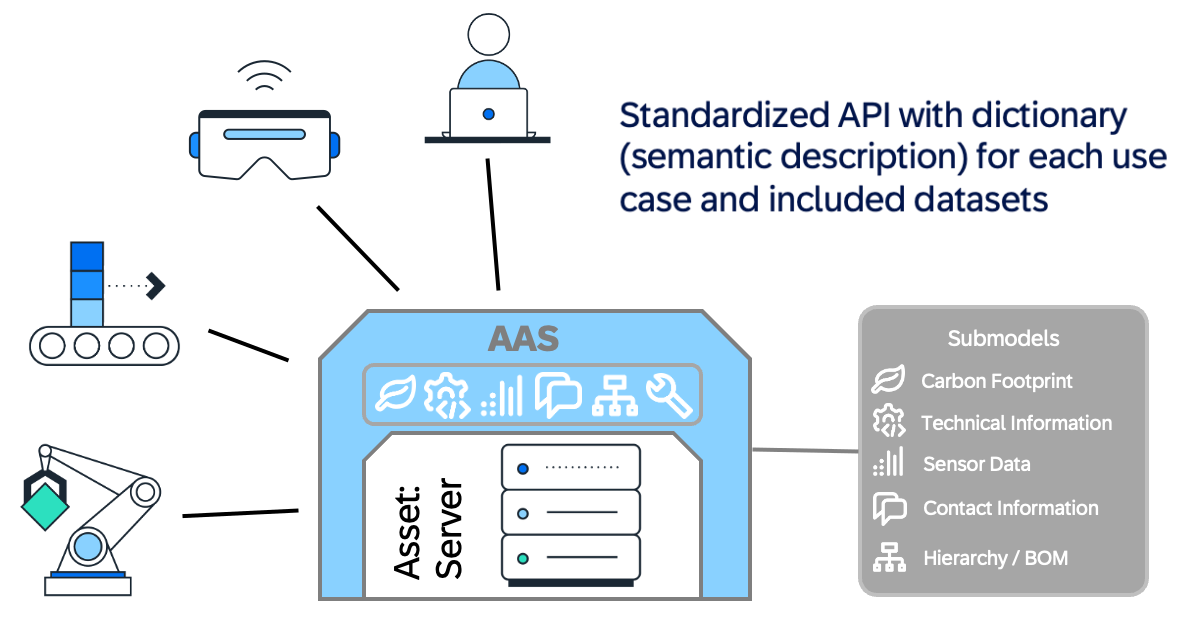
The AAS could also facilitate integration with external systems, such as configuration management databases (CMDBs), ticketing platforms, and analytics engines. This interoperability ensures that data flows seamlessly across the organization, enabling end-to-end traceability, automated compliance reporting, and the ability to respond rapidly to emerging risks or opportunities.
As the regulatory landscape continues to evolve, the flexibility and extensibility of the AAS become increasingly valuable. Organizations can adapt their digital twins and observability frameworks to accommodate new metrics, reporting requirements, or operational scenarios without the need for costly reengineering or vendor-specific customization.
Apeiro's reference architecture for data center observability, as detailed in the blueprint, establishes a modular, open-source foundation for scalable monitoring and analytics. The architecture is designed to be both robust and adaptable, supporting a wide range of deployment scenarios from greenfield sites to complex, multi-vendor legacy environments.

At its core, the architecture features a unified telemetry pipeline that collects real-time data from embedded monitoring units, PDUs, environmental sensors, and IT workloads using standardized protocols such as SNMP, Redfish, and OpenTelemetry. This data is normalized, enriched, and stored in an ELK-based data lake, ensuring consistency, traceability, and high performance for analytics and visualization.
A configuration management database (CMDB) acts as the single source of truth, linking telemetry data to both physical and logical assets. This integration enables effective asset lifecycle management, detection of configuration drift, and streamlined compliance reporting. Additionally, it supports advanced capabilities such as automated incident response and predictive maintenance.
Data quality and normalization are enforced through rigorous unit standards, canonical identifiers, and tagging conventions. Automated validation routines detect anomalies, out-of-range values, and data gaps, maintaining the reliability of both operational and sustainability metrics. Security and governance are integral to the architecture, with zero-trust security, role-based access control, encrypted secrets management, and immutable logging. Retention and archival policies are aligned with regulatory requirements, supporting auditability and long-term sustainability.
The architecture's modularity allows organizations to incrementally adopt new capabilities, including immersive visualization, advanced analytics, and AI-driven optimization, while maintaining continuity in existing operations. This future-proofing is essential for organizations seeking to stay ahead of regulatory changes, technological innovation, and evolving business needs.
The transition from compliance-driven reporting to continuous sustainability optimization is a defining feature of the Apeiro approach. By integrating sustainability metrics such as Power Usage Effectiveness (PUE), Energy Reuse Factor (ERF), Water Usage Effectiveness (WUE), renewable energy share, and CO₂ attribution, directly into the observability and immersive management layers, organizations can move from retrospective analysis to real-time, data-driven action.
Spatially contextualized sustainability data enables operators to identify inefficiencies, thermal hotspots, and underutilized capacity at a glance. Scenario simulation within the digital twin environment allows teams to evaluate the impact of operational changes, for example workload placement, cooling adjustments, and maintenance scheduling, on energy consumption and carbon footprint before implementation. This capability supports not only regulatory compliance but also strategic objectives for cost reduction, risk mitigation, and environmental stewardship.
Furthermore, the ability to attribute energy consumption and emissions to specific workloads, business units, or customers opens new possibilities for transparency and accountability. Organizations can set and track sustainability targets at granular levels, incentivize efficient behavior, and demonstrate progress to stakeholders, regulators, and the public.
The integration of sustainability into daily operations transforms it from a reporting obligation into a source of competitive advantage. Organizations that can optimize for both performance and environmental impact are better positioned to attract customers, partners, and investors who prioritize responsible digital infrastructure.
A practical application of this integrated approach is carbon-aware workload management. By attributing real-time energy consumption and CO₂ emissions to specific workloads and assets, organizations can make informed decisions about where and when to execute compute tasks. For example, immersive observability platforms can visualize the current CO₂ intensity of multiple data centers, enabling planners to simulate the effect of shifting workloads to locations with a higher share of renewable energy or lower marginal emissions.
Automated recommendations, grounded in business and operational constraints, can then be executed and audited, closing the loop between sustainability policy and operational reality. This pattern extends to other domains, such as phase balancing, breaker risk reduction, and water-aware cooling, always with measurable outcomes in terms of efficiency, resilience, and environmental impact.
The ability to simulate and implement carbon-aware operations in real time is a significant advancement over traditional, static approaches. It empowers organizations to respond dynamically to changes in energy markets, grid conditions, or regulatory requirements, maximizing both operational flexibility and sustainability performance.
The combination of the AAS, open telemetry protocols, and modular architecture ensures that the observability platform remains flexible and responsive to changing technologies, regulations, and business needs. Semantic stability via AAS submodels prevents vendor lock-in and dashboard drift, while governance mechanisms - such as versioned dashboards and regular data health audits - maintain trust and usability.
Apeiro's approach embeds immersive intelligence directly into data center operations, complementing sustainability and interoperability. This immersive layer enables teams to interact with operational and sustainability data in real time, visualise scenarios, and collaborate within dynamic digital environments. By uniting immersive experiences with open standards and robust governance, organisations can meet compliance and efficiency demands while leading in transparency, adaptability, and environmental responsibility.